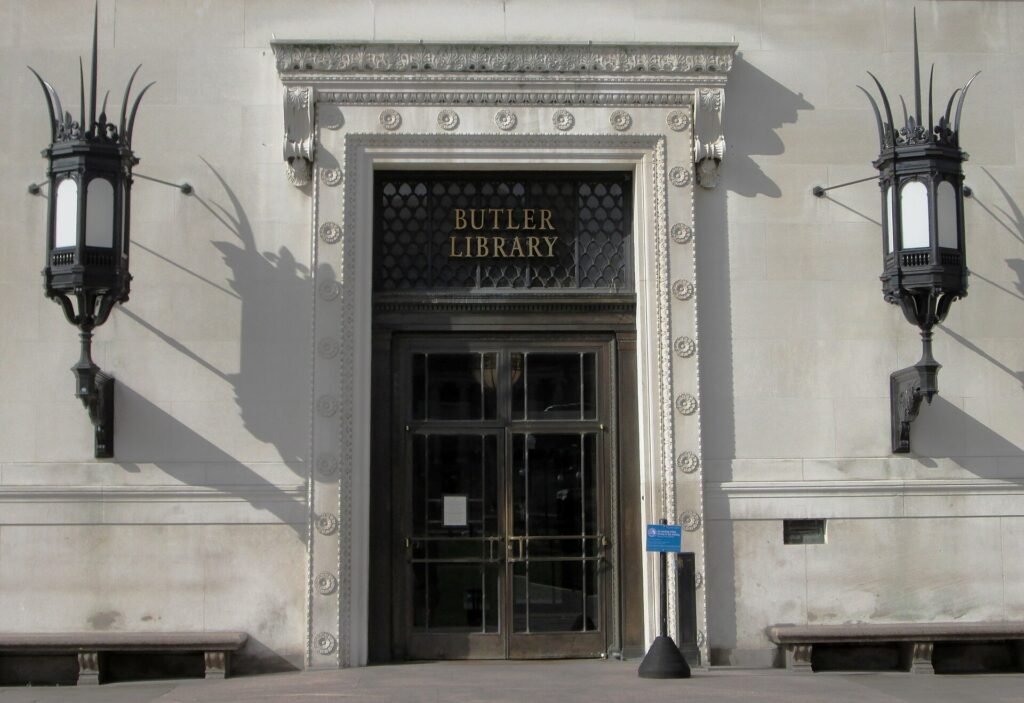
Every student in Columbia College starts college with a shared set of courses. The Columbia Core Curriculum is the group of required classes that makes this happen, and it is the best-known feature of an undergraduate education at Columbia. This guide explains what the Core includes, when students take each course and how the rules change for students in other Columbia schools.
For key facts about the university, see our Columbia University profile.
What the Columbia Core Curriculum includes
Columbia says five courses sit at the heart of the Core: Literature Humanities, Contemporary Civilization, Art Humanities, Music Humanities and Frontiers of Science. Columbia College students must also meet requirements in foreign languages, the Global Core, physical education and the sciences, and they take University Writing in their first year.
| Course | Formal name or note | When it is taken |
|---|---|---|
| Literature Humanities | Masterpieces of Western Literature and Philosophy | First year, both semesters |
| University Writing | A writing course | First year |
| Frontiers of Science | A science course | First year |
| Contemporary Civilization | Introduction to Contemporary Civilization in the West | Usually second year |
| Art Humanities | Required of every Columbia College graduate | Part of the Core |
| Music Humanities | Required of every Columbia College graduate | Part of the Core |
Year one: the courses every first-year takes
Columbia’s bulletin says students must finish Frontiers of Science, both semesters of Literature Humanities and University Writing in their first year. Literature Humanities and Contemporary Civilization are year-long courses, and with very few exceptions every first-year takes the first while every second-year takes the second.
Columbia publishes a Literature Humanities reading list on its Core Curriculum website, and the list changes over time. Check the current one if you want to see what students read.
Year two: Contemporary Civilization
Most students take Contemporary Civilization in their second year. Columbia treats Literature Humanities as a prerequisite for it, so College students must complete Literature Humanities first. Engineering students have an exception to that order because of how their programme is built.
Art Humanities and Music Humanities
Because both courses are required, everyone who graduates from Columbia College has taken them. Columbia’s art history department says that in limited circumstances a student may be eligible for an exemption from Art Humanities, so ask your advising dean if you think that applies to you.
The requirements around the Core
The Core sits alongside other rules that every College student must meet:
- Foreign languages. A language requirement applies to all College students.
- The Global Core. Columbia keeps a Global Core Navigator that lists the courses which count.
- Science. Frontiers of Science is joined by further science requirements.
- Physical education. This is also required.
Courses that fulfil the Core must be taken in Columbia College. The foreign language requirement is the exception, because in some cases it can be satisfied elsewhere if the relevant department agrees.
How the Core differs in other Columbia schools
Columbia has three undergraduate schools: Columbia College, the Fu Foundation School of Engineering and Applied Science and the School of General Studies. Their requirements are not the same. Engineering students take either Literature Humanities or Contemporary Civilization, either Art Humanities or Music Humanities, University Writing and a course called the Art of Engineering. Columbia says that requirements differ across its schools, so check your own school’s bulletin and speak to your advising dean.
Where the Core came from
According to Wikipedia’s account of the history, the Core began in 1919 with Contemporary Civilization, which faculty presented as a course on the issues of the post-war world. The humanities sequence that became Literature Humanities was added in 1937 under the name Humanities A. The reading list has changed over the decades. Toni Morrison’s novel Song of Solomon was added to Literature Humanities in 2015.
What the Core means if you want to apply
The Core gives students a common reading experience. A Columbia student blog on the Core says the shared courses create a sense of community, because nearly every first-year takes the same course and nearly every second-year takes the next one.
That structure suits some students more than others. If you want a broad start across literature, ideas, art, music and science, the Core delivers it. If you would rather choose your own courses from the first semester, weigh that before you apply. Questions about the five Core courses can go to the Center for the Core Curriculum, and questions about University Writing go to the Undergraduate Writing Program.
Frequently asked questions
What is the Columbia Core Curriculum?
It is the set of courses that Columbia College students must take, built around Literature Humanities, Contemporary Civilization, Art Humanities, Music Humanities and Frontiers of Science.
When do students take Contemporary Civilization?
Most students take it in their second year, after finishing Literature Humanities.
Do Columbia Engineering students take the Core?
They take a version of it. Engineering students take either Literature Humanities or Contemporary Civilization, either Art Humanities or Music Humanities, University Writing and the Art of Engineering.
Can a student skip a Core course?
Columbia says exemptions from Art Humanities are possible in limited circumstances. Other Core courses must be taken in Columbia College.
Where can I find the current reading list?
Columbia publishes Literature Humanities reading lists on its Core Curriculum website.
Requirements can change. Always confirm the current rules in the official Columbia College Bulletin.
Sources: Columbia College, The Classes, Columbia College Bulletin, Academic Requirements, Columbia College and Columbia Engineering, the Core, The Core, Explained, Columbia Art History, Art Humanities and Wikipedia, Core Curriculum (Columbia College).