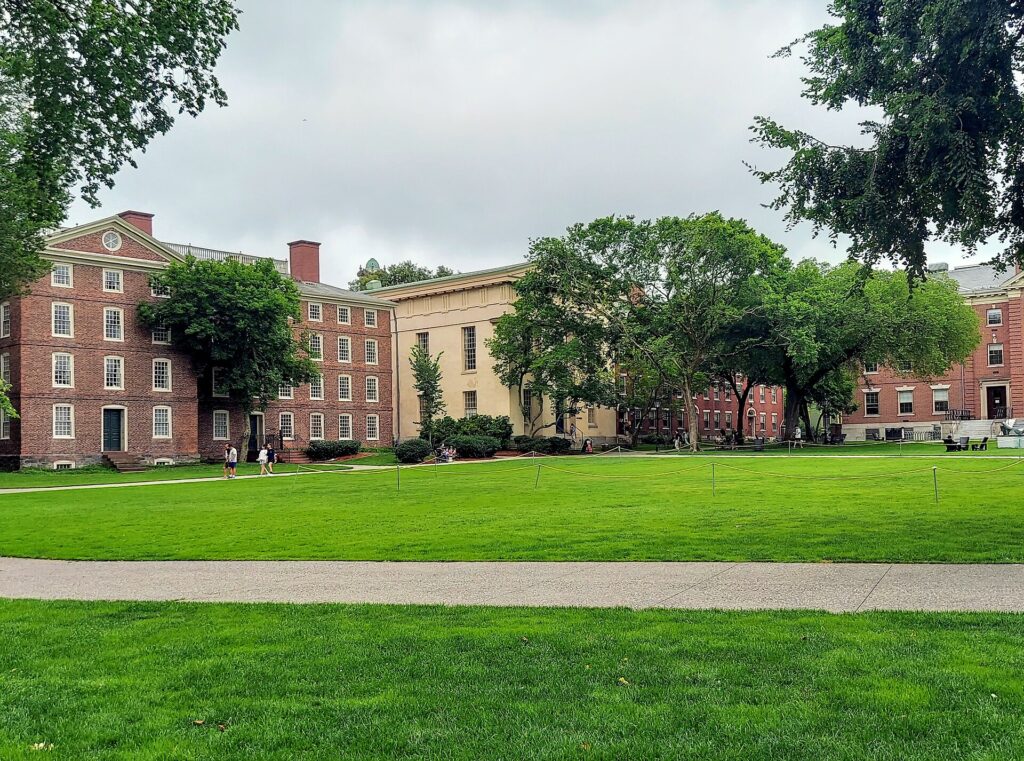
Most universities tell you which classes you must take before you can graduate. Brown University mostly does not. The Brown Open Curriculum, in place since 1969, lets undergraduates choose almost every course themselves, as long as they finish 30 courses and a concentration. This guide explains how the Open Curriculum works, where it came from, what it asks of students and what it means when you apply.
For key facts about the university, see our Brown University profile.
What is the Brown Open Curriculum?
Brown’s admissions office says the university has no required core curriculum and no distribution requirements that students must complete to graduate. At many universities, distribution requirements make every student take a set number of courses in areas such as science, humanities and social science. Brown removes that layer. The main rules are that a student passes at least 30 courses in eight semesters and completes at least one concentration, which is Brown’s word for a major.
The freedom has limits. A concentration has its own required courses, and Brown’s admissions page notes that a chosen area of study may carry specific requirements and broader recommendations. So the choice is wide, but it sits inside the structure of the concentration you pick.
Where did the Open Curriculum come from?
The idea came from students. Brown’s curriculum page explains that the plan grew out of a report by undergraduates Elliot Maxwell and Ira Magaziner, written as part of a group independent study project about education at Brown. The new curriculum removed all distribution requirements and added a credit or no credit grading option. Brown adopted it in 1969.
Brown links the idea to an older argument. In 1850, its fourth president, Francis Wayland, said students should “study what he chose, all that he chose, and nothing but what he chose.” A century later that view became the basis for the open curriculum.
What do you need to graduate?
Brown’s published rules are short:
- Pass at least 30 courses in eight semesters.
- Complete at least one concentration.
The Brown Bulletin adds that the curriculum does not require distribution or core courses outside the concentration. It says more than 2,000 undergraduate courses support more than 80 concentrations, many of them interdisciplinary, along with a wide variety of independent studies.
What ideas sit behind it?
Brown says the Open Curriculum rests on three ideas:
- Students should take an active role in their education and take responsibility for the direction of their learning.
- Undergraduate education is a process of individual and intellectual development, not only a way to pass on a fixed body of information.
- The curriculum should encourage individuality, experimentation and the joining together of different subjects.
Brown also says students can build their own core instead of following a list of areas that the university has chosen for them.
Freedom and responsibility, side by side
| What you gain | What you take on |
|---|---|
| Choice of courses based on your own interests | Deciding for yourself what a broad education means |
| Room to change direction as your interests change | Checking that your concentration still fits inside eight semesters |
| The option to study two areas through a double concentration | Making sure both sets of requirements leave room for other courses, as Brown advises |
| A credit or no credit option for some courses | Reading the current rules on how that grade is recorded before you rely on it |
Who does the Open Curriculum suit?
Our view is that it suits students who like to plan and who ask for advice. If you already have two or three subjects pulling at you, the freedom to combine them is a real advantage. If you prefer to be told what to take next, the same freedom can feel like a lot of decisions.
That is not a weakness in either direction. It simply means you should be honest about how you work. Brown reports a student-to-faculty ratio of 6 to 1 and says all of its faculty teach undergraduates, so there are people to ask. You still have to ask.
What does it mean when you apply?
Brown’s own numbers for the Class of 2028 show how competitive entry is. The university received 48,904 applications and admitted 2,638 students, an acceptance rate of 5.4 percent. Of those, 898 were admitted through Early Decision, and the first-year class had 1,724 students. Early Decision at Brown is binding, so you should apply that way only if Brown is clearly your first choice.
Because the Open Curriculum depends on self-direction, it helps to show how you would use the freedom. Real questions, projects and examples give admissions readers more to work with than a general statement that you love flexibility. If you are applying from outside the United States, also read our guide to need-blind vs need-aware admission.
Frequently asked questions
Does Brown have a core curriculum?
No. Brown says it has no required core curriculum and no distribution requirements that students must complete to graduate.
How many courses do I need to graduate from Brown?
Brown requires at least 30 courses in eight semesters, along with at least one concentration.
Can I take a course without a letter grade?
Brown introduced a credit or no credit option with the Open Curriculum. Check the Brown Bulletin for the current rules before you plan around it.
Can I study two subjects at once?
Yes. Brown suggests a double concentration if your interests span two distinct areas and the requirements for both still leave room for a wide range of other courses.
Does Brown require the SAT or ACT?
Reports based on Brown’s Common Data Set say Brown has reinstated its testing requirement. Policies change, so confirm the current rule on Brown’s admission website.
Admission rules and statistics change every year. Always confirm the current details on the official Brown website.
Sources: Brown, The Brown Curriculum, Brown Undergraduate Admission, About Brown, Brown Bulletin, Foreword, Brown Admission by the Numbers, Brown Alumni Magazine and Open Minds.